Black Rabbit Tattoo
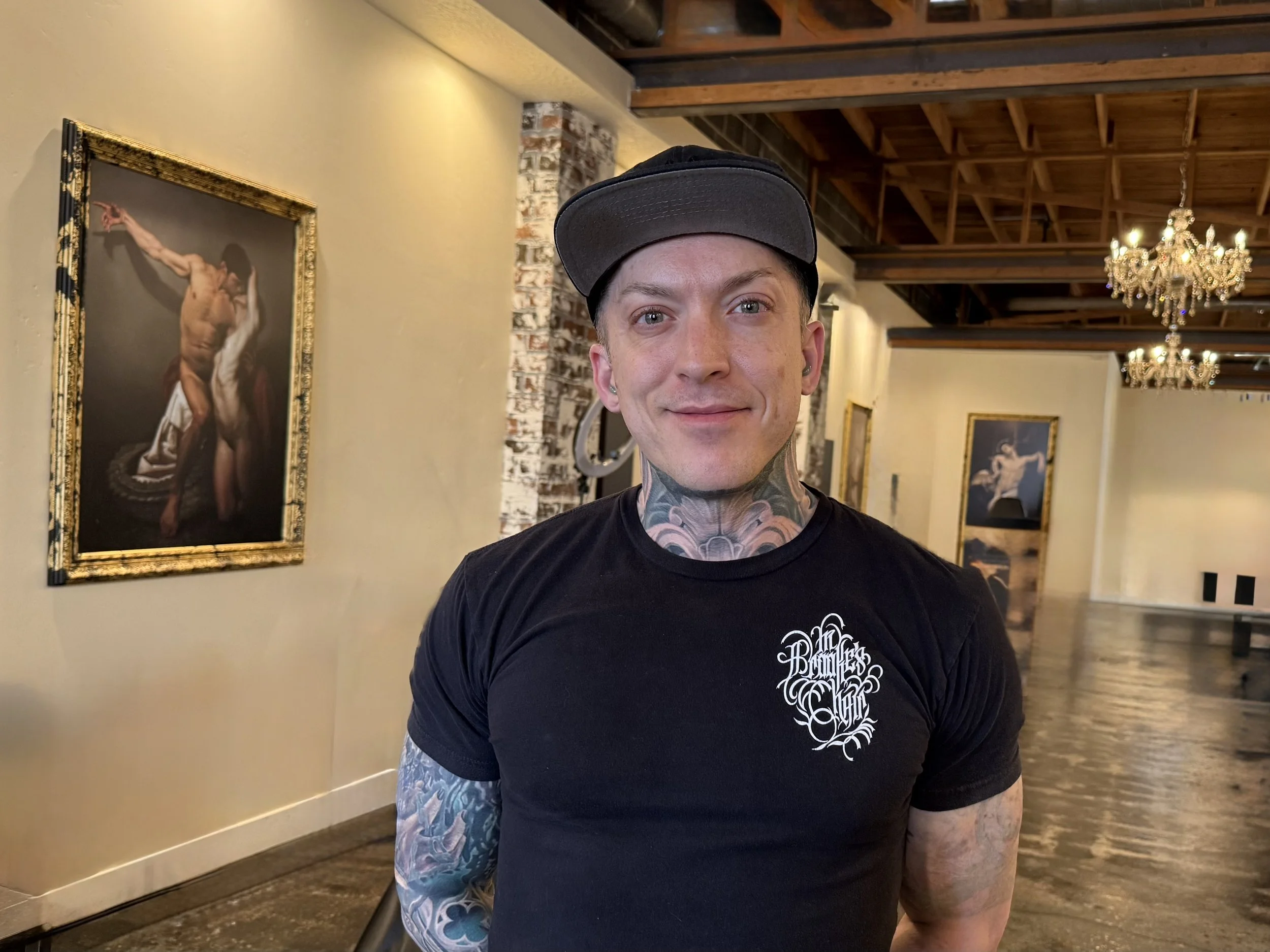

“This job is an insane luxury.” Buck Harvey, owner of Black Rabbit Tattoo, says it with the kind of clarity that comes from living long enough on the other side of it - the years when nothing felt stable, money was tight, and he had a little girl at home, Ava, depending on him.
Buck was born in Washington, D.C., and his family moved when he was five to a rural area on the coast of Virginia. He grew up in the woods, in a small town. “I think because of just the sheer lack of things to do, art just kind of consumed me.” With no internet and limited access to museums or classes, his first real exposure to art came from whatever he could find. “When I was a little kid, I was copying characters in comic books.” He drew what he saw, over and over, until fascination became a kind of identity.
By his teen years, Buck had moved beyond copying and into making his own work. “Once I hit my teen years, I got into painting, and then started drawing more, and started realizing, this is what I want to do with my life. I want to make art.” After graduating high school in 1999, he enrolled in the art department at the University of North Carolina at Charlotte and stayed for three years. Right before his senior year, he quit - not because he stopped caring about art, but because he became aware of what was happening to people around him. “I was watching them graduate with an art degree, and then immediately go back to their bartending or serving job, and it hit me all of a sudden that it was not as easy as: get a degree, and then suddenly you are making money as an artist.”
Debt piled up early. Buck left school to deal with it and stepped into bartending with a plan - pay everything down and then figure out his future. Instead, the industry pulled him in. “I very quickly fell into the party life, the nightlife scene, and I stayed in that way too long.” What was supposed to be temporary lasted about fifteen years. “I was in my mid-thirties by the time I finally got out of bartending and used tattooing as an escape route.” He did his first tattoo at thirty-two. “Definitely far later than most.”
During his time in Charlotte, Buck met Ava’s mother. "We were pregnant almost immediately.” He tried to make a family out of the situation, but it did not hold. When Ava’s mother received a job offer in Salt Lake City, she moved with Ava, and Buck followed right away. “That was how we ended up out here.” They arrived in 2008 when Ava was two, and Buck came as a bartender, assuming he could work the way he had back east.
Salt Lake City surprised him. Buck remembers searching online for nightclubs and thinking he had found endless options. "Before I left North Carolina, I was looking at this list of thousands of locations and thought Salt Lake must be the nightclub capital of the world.” Then he arrived and realized it was a misunderstanding shaped by Utah’s liquor laws at the time. “I quickly realized that there are no nightclubs out here.” The money was not there the way it had been back east. “Out here, I was working at four different venues and barely making ends meet.” It was terrifying, and it forced a harder truth into focus - Ava was growing up, and he needed to become someone who could raise her. "Her mom was not in a position to do this, so I needed to get out of that industry, get myself sober, get myself organized, and create a better future for Ava and me.”
Tattooing did not come easily. “I was trying to get into the industry in the form of an apprenticeship, and I simply could not get my foot in the door anywhere.” He describes that moment plainly. “I took the path that the tattoo industry condemns the most, which is being self-taught.” He bought what he could find online. Someone let him practice on them. “It worked, and I was shocked, because I realized that this actually does not look bad.”
At the same time, life was intense at home. After moving to Utah, Buck and Ava’s mother tried to work together because they did not know anyone else, but it did not last. “Before we knew it, we found ourselves in a custody battle that went on for close to eight years.” It was daily life. It was the reason he kept going. It was also the beginning of Ava’s own creative path. “I eventually got full custody of my daughter, and that is where I was really able to start molding her into the artist she wanted to become.” At age twenty, Ava is tattooing full time at Black Rabbit, and according to her proud dad, "she is unbelievable.”
Prior to opening Black Rabbit, Buck spent two years tattooing out of his house, which he will be the first to admit sounds insane. The health department would inspect a home studio, but the city would not grant a business license for it, and he needed a license to purchase equipment. He created a separate basement entrance so clients did not walk through his home and made it look as much like a professional shop as possible. He kept the health department permit visible to reassure people. “The first thing you saw was that it was clean, and that I am organized, I am responsible.”
The home studio began to take off - almost too visibly. His brother helped spread the word, and Buck built a clientele, but the cars coming and going made neighbors uneasy. When his landlord found out, it was clear he had to move into a real shop. By then, Buck had built enough of a portfolio to get hired in a studio. Working for someone else confirmed what he already suspected. “I hated working for other people.” He told the shop owner his plan up front. “I want to be here for exactly two years and then open up my own thing.” Two years later, he did.
Buck opened his first commercial location in 2016 - a small building cheap enough to sign the lease without panic. Over time, he added artists, grew the clientele, and raised the standards. In 2020, he moved Black Rabbit into the larger space it occupies now and renovated it into the studio he had been trying to build since the basement days. “It is a trip where it started from and where it currently is.” In 2026, Black Rabbit is approaching its ten-year anniversary with “no signs of slowing down.”
The name Black Rabbit began earlier, and it began with Ava. When she was a baby, someone gave her a rabbit bathrobe with floppy ears. “The only thing that she would agree to wear was this rabbit bathrobe.” Buck started calling her Bunny, and he still does. Around that time, he began painting her each year, and the first painting became the seed of the business name. In it, Ava sits in a green field surrounded by rabbits bringing her giant carrots, and a black rabbit rests in her lap. As she got older, Ava kept returning to one detail. “She would always talk about how much she loved the black rabbit the most.” When Buck was thinking aloud about a studio name, Ava said, “What about black rabbit?” Buck remembers it sticking immediately. He places that moment around 2012, when Ava was about six.
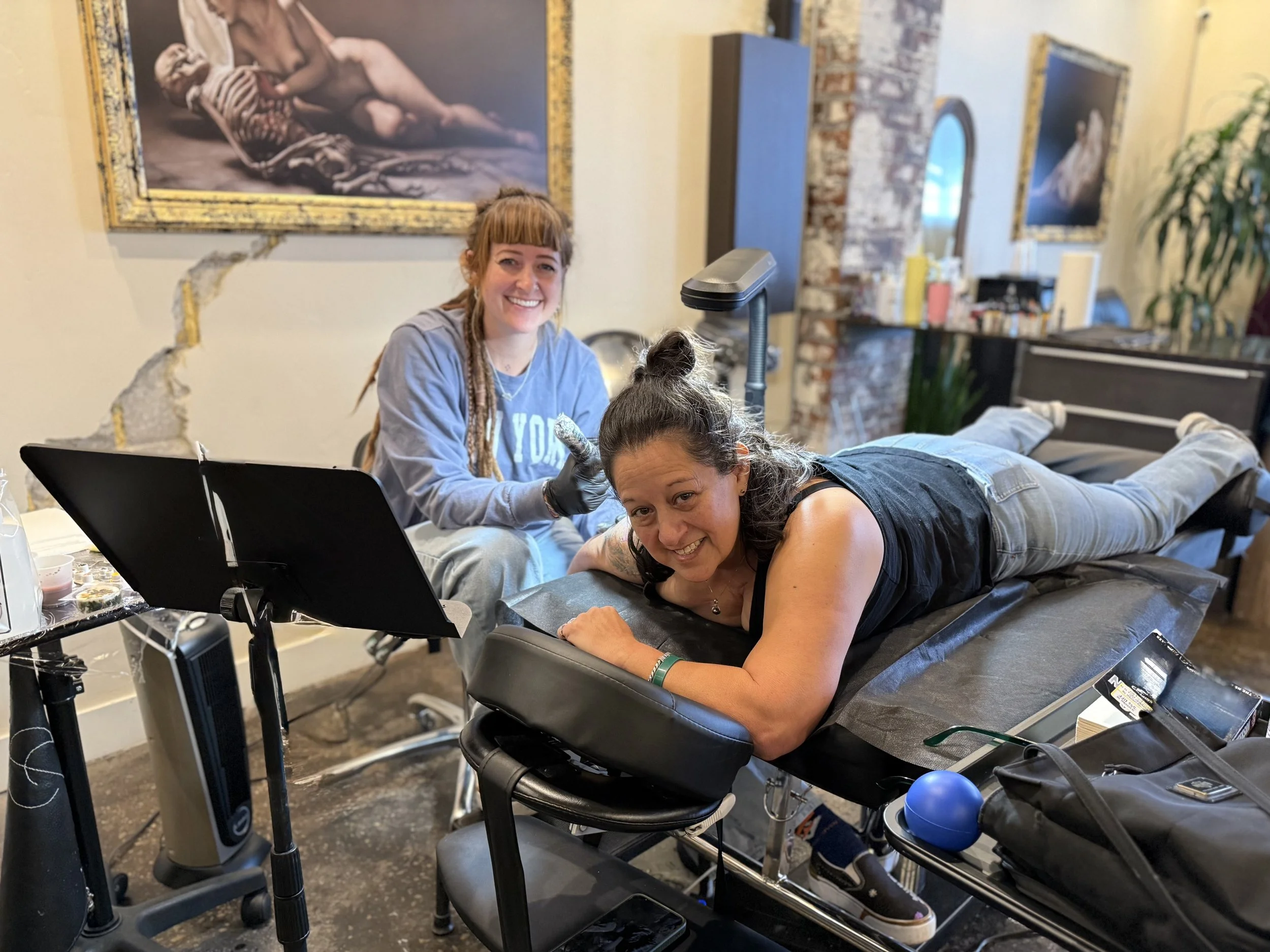
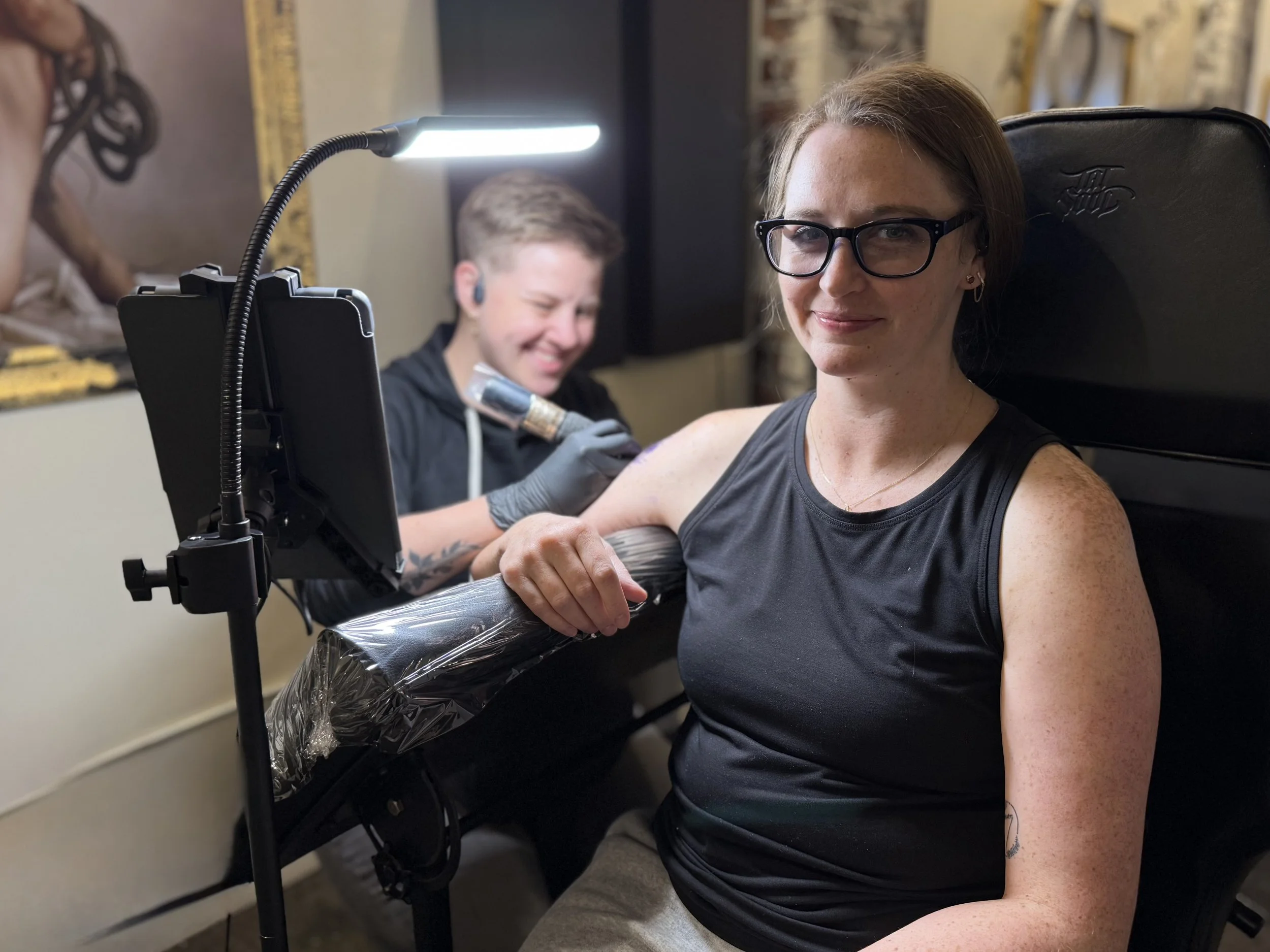
Ask Buck what sets Black Rabbit apart, and he goes straight to how clients are treated. “We have a relentless commitment to our client’s comfort.” He keeps the doors locked so appointments stay focused and private. “We want to make sure that our client’s time is their time.” He is blunt about what clients go through, especially with the large-scale work the studio often does - long sessions, pain, vulnerability, and the reality that some projects require people to be partially uncovered in order to be tattooed. He also thinks about what happens before anyone even arrives - time off work, childcare, the logistics of rearranging a whole day. “There is so much that they have to do to even get to a point where they can come in here.” That awareness drives how he runs the experience down to the details. “Heated tables, drinks and snacks, blankets and pillows, literally anything they could possibly need to keep their day as comfortable as possible.”
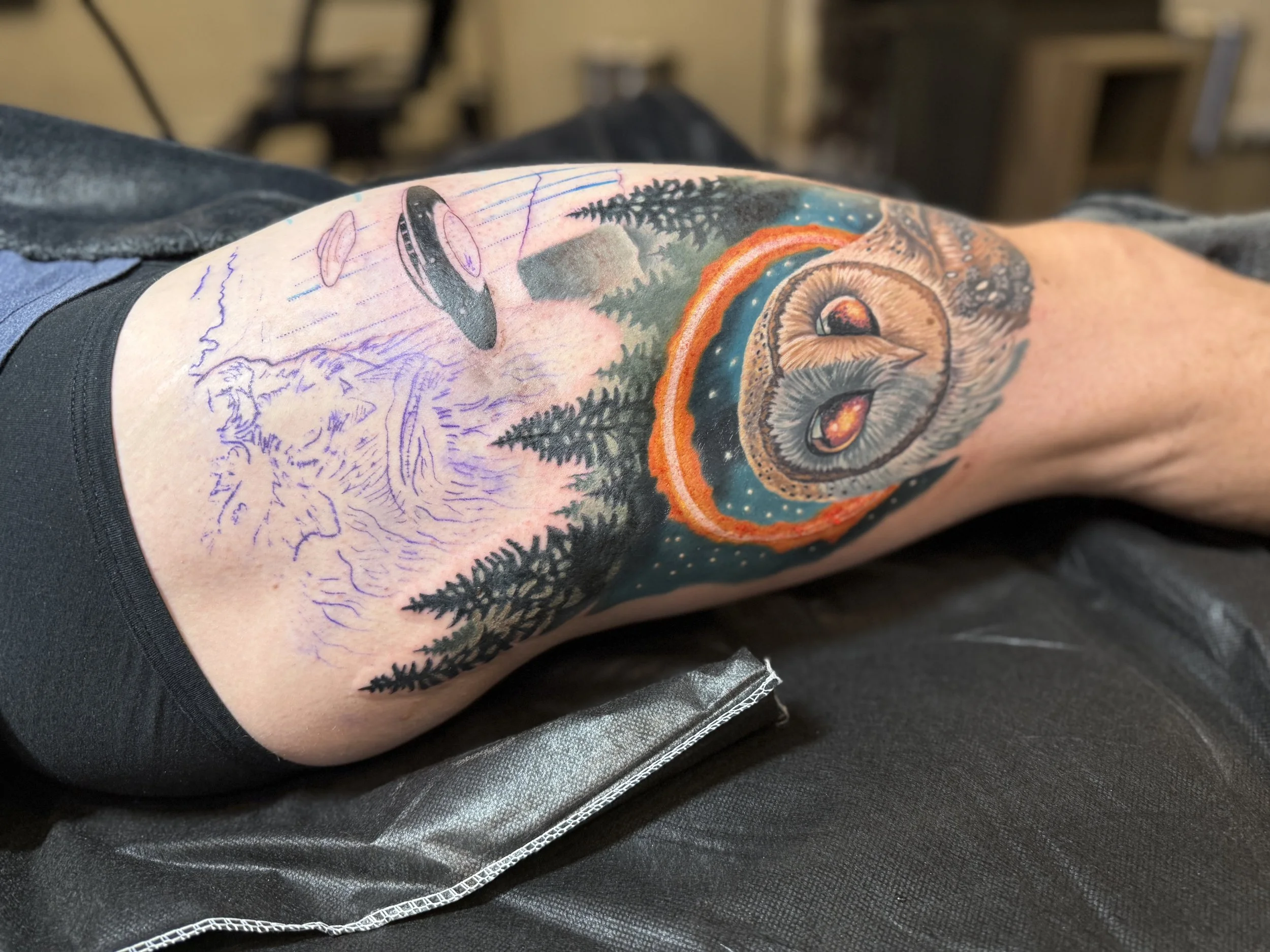
Buck also names a second difference that sets Black Rabbit apart from other tattoo parlors, one rooted in skill and in trust. He specializes in what he calls impossible cover ups. “I take these former tattoos, as is, and I bury them to the point where you cannot see a trace of the existing tattoo.” He does not require clients to laser first. “Not for me. No, I can tattoo over it.” He says it without hesitation. “I am very confident at this point that I can cover literally anything.”
But the part of the work that matters most to him is not the bragging rights - it is what tattoos can do for someone who needs a new way to live in their own body. “As ridiculous as this sounds, it has the potential to be life changing for people.” Buck has covered brutal scars from accidents, surgeries, and abuse. He has helped people move through grief, including a mother who wanted a sleeve created from her daughter’s art after her daughter died unexpectedly. “It transformed this woman’s grieving process.” Buck does not deny that some tattoos are simply done for the fun of it, but he wants people to understand the deeper side. “There is so much more to this than just vanity.”
Black Rabbit is also a team. In early 2026, there are nine artists total, including Buck, and he speaks about his staff the same way he speaks about clients - with respect and gratitude. “I could not do this business without my artists.” Some came because they liked his work. Many came because they wanted structure in a studio culture that can be chaotic elsewhere. “They are attracted to the way that I run things, because everything is so consistent, so methodical.” Buck is honest about his personality. “I am very type A.” In his mind, it is not about control. It is about creating a dependable place where artists can focus and clients can feel safe. “None of them ever have to wonder what today is going to be like, because I make sure that it is the same as the other days.”
And when Buck talks about how far this has all come, he does not skip the people who helped him get here. His brother, who was stationed in Salt Lake with the military, pushed him hard in the beginning and offered his own skin as Buck learned. “I credit my brother for getting me to where I am today.” His brother is back in Salt Lake now, and the three of them - Buck, Ava, and the man who believed in him first - recently shared a moment that felt like everything was coming full circle. “I was tattooing him with Ava by my side, which was pretty surreal.”
From a kid in the woods drawing comic book characters, to a young man chasing an art degree and getting swallowed by debt, to a father getting sober for his daughter, to a self-taught tattooer building something professional out of a basement - and finally to a studio where his daughter now works beside him - the path has not been simple. Through it all, Buck has stayed focused on one thing - the work matters because people matter. “This has the potential to change the course of someone’s life. Those are the projects that make me feel like I am actually doing something with my heart, not just paying my bills. And I will never forget that without our clients, none of this would exist.”